







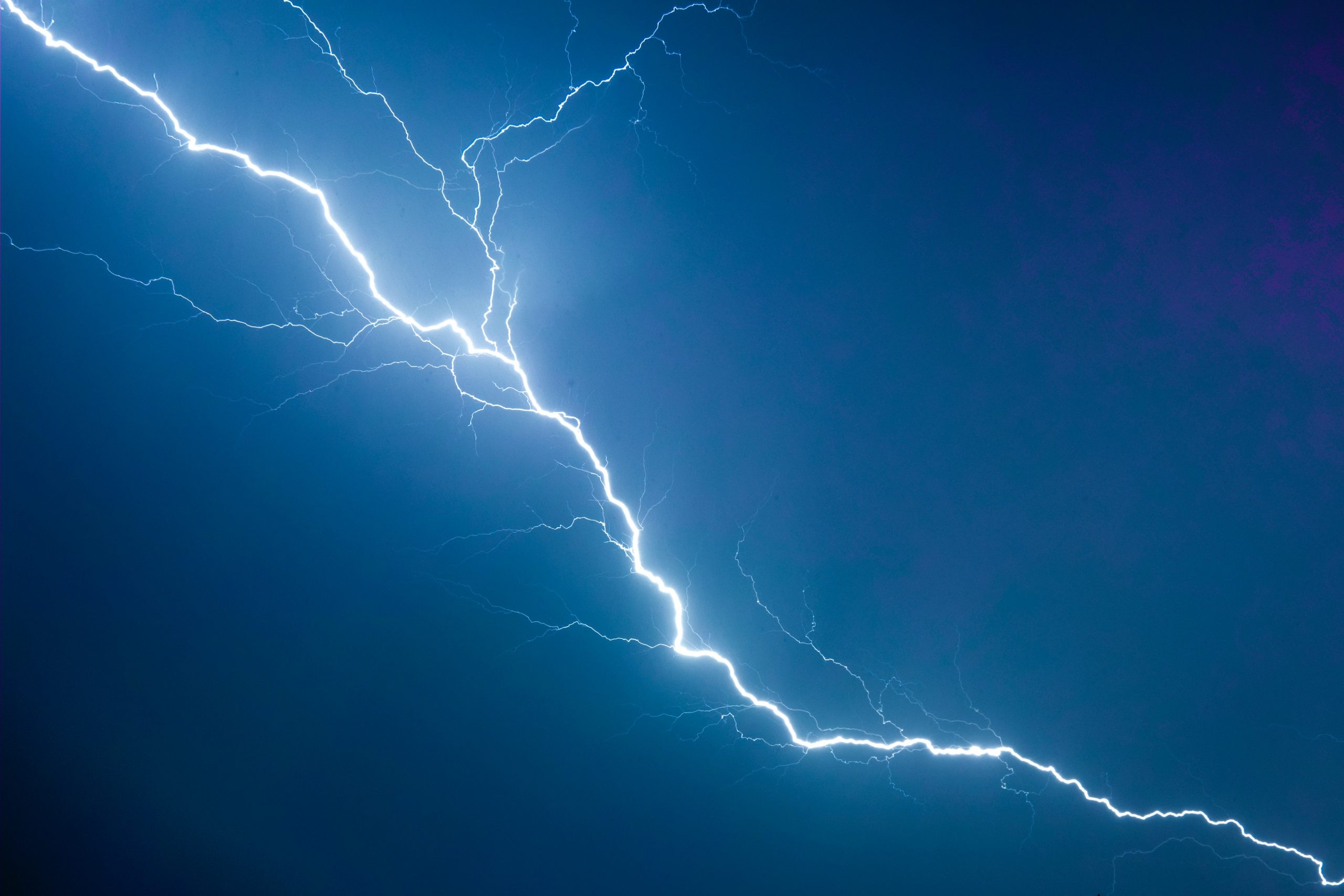
One of the most beautiful and awe-inspiring things is to have a water’s-edge view as a storm builds and works its way in across a lake. There is something about watching the clouds billow and darken, the waves picking up in size and intensity, and the raw power of the lightning as it almost seems to crackle across the surface of the water, that reminds you of just how puny and powerless you really are.
Well, it would seem that King David may have had similar thoughts, because in the psalm we are going to look at today, he uses the imagery of a violent storm to describe the breadth of glory and strength found in our God, and presents it as the fuel and inspiration for our worship.
It’s never a bad time for us all to hear some reminders of just how great and deserving of worship our God is, and we’re going to find that today in Psalm 29. Specifically, we’re going to see in David’s words a What, a Why, and a Now What? What does God deserve? Why does he deserve it? And Now What do we do about it?
SERMON MANUSCRIPT
Growing up where I did near the shores of Lake Huron, you get used to a lot of bad weather. From unexpected blizzards and closed roads in the winter, to heavy wind and lightning storms in the other three seasons, sometimes even accompanied by a tornado warning if the day is right. And with such quick and violent atmospheric changes, often times seemingly popping up out of nowhere with no regard for what the meteorologists predicted, you have little choice but to learn to take the storms seriously. Always keep a set of warm clothing in the car and never let your gas get too low in the winter. Always know where the candles and flashlights are in case the power goes out (again). Always have a well-stocked pantry and freezer in case the roads close for days at a time and you can’t get to the grocery store.
Yet despite all the potential reasons to fear, and the required disaster preparedness (which is actually increased by the fact that the world’s second largest nuclear power plant is 5 minutes down the road…but that’s a discussion for another time!); despite the respect the locals have for the sheer unpredictable devastation of the weather, ask almost anyone there and they will tell you that one of the most beautiful and awe-inspiring things is to have a water’s-edge view as a storm builds and works its way in across the lake.
There is something about watching the clouds billow and darken, the waves picking up in size and intensity, and the raw power of the lightning as it almost seems to crackle across the surface of the water, that reminds you of just how puny and powerless you really are.
Well, it would seem that King David may have had similar thoughts, because in the psalm we are going to look at today, he uses the imagery of a violent storm to describe the breadth of glory and strength found in our God, and presents it as the fuel and inspiration for our worship. On a day like today that is so celebratory and praise-filled, as a brother in Christ publicly partakes in the act of baptism, I thought it wouldn’t hurt for us all to hear some reminders of just how great and deserving of worship our God is.
I invite you to turn with me to Psalm chapter 29, and as I often like to do, we’re going to start by reading the whole psalm, and then we’ll come back through and take it in smaller pieces. Specifically, we’re going to see in David’s words a What, a Why, and a Now What? What does God deserve? Why does he deserve it? And Now What do we do about it?
WHAT DOES GOD DESERVE (1–2):
This psalm opens with an interesting word: ascribe. Your translation may say “give”, or perhaps even “acknowledge”. It’s sort of the idea of giving someone what they are due. Acknowledging how much you owe them. Assigning a set of values to them. Which is why I call it interesting, given that God is God, and there is nothing we can give to him that he needs, even though in many ways we might say we owe him everything we possibly have to give. Look back at verse 1.
Ascribe to the Lord, sons of the mighty,
Psalm 29:1 NASB
Ascribe to the Lord glory and strength.
How do we give God glory and strength when his glory and strength are already limitless? Well the simple answer is that we don’t. But we can reverently acknowledge that he has all glory and strength, and that he deserves any glory and strength we have to offer.
I have a friend who has some money, and he isn’t afraid to spend it. And he gives incredible gifts at Christmas and birthdays, or even just out of the blue for no reason. But, wouldn’t you believe it: buying a gift for him is a nightmare. It’s so hard, because anytime there’s something he wants, he just buys it himself. The result is that you end up having to put a lot of thought, care, and intention into what you get him. And in return, he always does a really good job at showing just how much he appreciates the gift, even if by dollar-to-dollar value, it’s nowhere near as much as he spent on you.
That’s sort of the picture I have here. God has given us more than we could ever ask for or imagine. He paid a hefty price, sending his own Son to die on our behalf so that we can be saved. And there is absolutely nothing we can do to repay him, to match the value of the gifts he has given us. But what he wants is our thoughts and care and intention. Our time, our effort, our actions, our prayer, praise, and worship. Not because he needs it. Not because it somehow repays our debt. Not because it earns his favour or his love or makes us even. But because he is the almighty God, and he deserves it!
Verse 2 says:
Ascribe to the Lord the glory due His name;
Psalm 29:2a NASB
“His name” is like a stand in for his entire being. His character, his identity, who he is as God. He deserves an ascription of all glory, simply because of who he is. In the second half of the verse, the verb changes. It’s still an imperative, a command, but after the threefold “ascribe”, we now have “worship”. But notice what it says in the second half:
Worship the Lord in holy attire.
Psalm 29:2b NASB
To me this seems like a call to worship God the way he deserves and demands to be worshipped. Taking our worship seriously, and again, acknowledging the one whom we are worshipping. Now, this isn’t necessarily referring to our actual clothing, and what we need to wear to worship God. In fact, recently my wife threw out some of my clothes for being a little too hole-y. Instead, it’s probably more of a heart posture: how we present ourselves to God in our worship.
I think of Colossians 3:12–13,
So, as those who have been chosen of God, holy and beloved, put on [or clothe yourselves with] a heart of compassion, kindness, humility, gentleness, and patience; bearing with one another, and forgiving each other, whoever has a complaint against anyone; just as the Lord forgave you, so must you do also.
Colossians 3:12–13 NASB
So, when we approach the strong and glorious Lord, we ought to clothe ourselves, wrap ourselves in holiness. Again, complicated, perhaps, by the fact that we are not holy. And yet that is the call, multiple places throughout scripture. 1 Peter, Leviticus, 1 Peter quoting Leviticus. But again, I think of Paul’s words, this time to the church in Rome, in Romans 12:1,
Therefore I urge you, brothers and sisters, by the mercies of God, to present your bodies as a living and holy sacrifice, acceptable to God, which is your spiritual service of worship.
Romans 12:1 NASB
The reality is that God is perfect, and we are not. Yet that doesn’t let us off the hook, and it’s something we ought to be reminded of time and time again as we turn to worship him with our words, deeds, prayers, songs, and life. Take our time of corporate worship, for instance. Our gathering on the Lord’s Day to sing and pray and take communion and learn from God’s word. One thing I’ve been reflecting on this week, is how often during a Sunday morning service do I actually take the time to think about how glorious and strong and holy and deserving of worship our God truly is? Or are there times when I just sing along because that’s what we do.
Or how about the question “why do we do what we do?” Why do we sing? Why do we stand while we sing? Why do we bow our heads and close our eyes when we pray? Why is there someone leading us in prayer, and not just private prayer time? Why is there silence after communion? These are all things we do, choices we’ve made with intention, and yet for those of us who have been around church for a while, it can be easy at times to take it all for granted and just go through the motions. To sing the words without truly reflecting on what we’re singing. To bow in prayer while our mind wanders from what the person is praying. To think more about the flavour of the grape juice and the piece of wafer stuck in our tooth than the meaning behind the bread and the cup.
But for anyone who might be new, or just visiting church for one of the first times, most of what we do on a Sunday morning is just plain weird. And I’m sure it’s noticeably weird. Yet here we come, week after week and sing, pray, sing some more, eat, drink, reflect, read, listen, and fellowship out of reverent acknowledgement for our Lord, doing our best to worship him the way he deserves to be worshipped. To present ourselves as clothed in holiness, even when we’re far from it. Because the Lord of glory and strength deserves our best, our life, our everything.
WHY DOES HE DESERVE IT (3–9):
In the next section of verses, David goes into some vivid imagery to explain why God deserves our worship. Yes, we already acknowledged that he’s deserving of worship just because of who he is, but here David wants to flesh out that glory and strength with a little more detail.
The first thing I’m sure many of you noticed when we went through the passage before is just how much repetition there is. Specifically, the phrase “The voice of the Lord” is repeated seven times in these seven verses. Now, the number seven stands out because it’s all throughout scripture and Hebrew culture, often thought of as the number of perfection and completion. I won’t waste too much time on theories of biblical numerology, but suffice it to say, when I read about the “voice” of the Lord, and notice that it’s referred to seven times, my mind goes right to creation. Six days of God creating, speaking our world and all we know into existence, and on the seventh day, resting. If that isn’t a story about the absolute limitlessness of God’s glory and strength, I don’t know what is.
But while God’s voice in creation may draw us to peace-filled gratitude and awe, as we think about the marvelous wonders of nature and all that God has made, there are many times in scripture that it elicits another reaction. Specifically, thinking of this thunderstorm imagery, I think of the experience of the Israelites hearing God at Mt. Sinai with Moses.
So it came about on the third day, when it was morning, that there were thunder and lightning flashes and a thick cloud over the mountain and a very loud trumpet sound, so that all the people who were in the camp trembled. And Moses brought the people out of the camp to meet God, and they stood at the foot of the mountain. Now Mount Sinai was all in smoke because the Lord descended upon it in fire; and its smoke ascended like the smoke of a furnace, and the entire mountain quaked violently. When the sound of the trumpet grew louder and louder, Moses spoke, and God answered him with thunder . . . And all the people were watching and hearing the thunder and the lightning flashes, and the sound of the trumpet, and the mountain smoking; and when the people saw it all, they trembled and stood at a distance. Then they said to Moses, ‘Speak to us yourself and we will listen; but do not have God speak to us, or we will die!’
Exodus 19:16–19; 20:18,19 NASB
The voice of the Lord was terrifying to the people, as they bore witness to God’s glorious power in a way that made evident just how unholy they were by comparison. It’s not so different than Adam and Eve walking and talking freely with God in the garden, then immediately wracked with fear and shame after their sin.
When we witness a glimmer of the breadth of God’s glory and strength, it makes sense that we might experience awe and reverence: he is a great, majestic, God! But it also makes sense that we might experience, like the Israelites, fear and trembling, as we realize just how sinful and weak we are in comparison to a perfect, holy, powerful God. They’re two sides of the same coin, and both can be proper, worshipful responses to the almighty. And if I’m being honest, sometimes I focus a little too much on the beauty side, and not enough on the fear side. My sin is serious, and part of “worshipping in holy attire” is treating it with the seriousness it deserves when facing the God of glory and strength.
So let’s do what David intended and reflect on and acknowledge the sheer power of God, and just how far-reaching his glory is. There is certainly no shortage of strength-demonstrating terminology in these verses. Verse 3b, “The God of glory thunders”. Verse 4a, “The voice of the LORD is powerful”. Verse 5, “The voice of the LORD breaks the cedars; yes, the LORD breaks the cedars of Lebanon in pieces”. Because snapping trees isn’t enough, David picks some of the tallest, strongest, most well-known trees in the area and make it clear that God can shatter them to pieces. Our modern, western version might say “He runs the redwoods of California through the woodchipper”.
Verse 6 might seem a bit strange, but contextually, the “Lebanon” and “Sirion” that “skip like a calf” or “like a young wild ox” refer to two massive mountain peaks in the region. The imagery is of a God so powerful, he makes the mountains bounce and skip around like a young cow. A voice that trembles the earth. Verse 8, it shakes the entire wilderness.
And yet for all that expansive, chaotic, breadth of power, he also uses imagery that demonstrations precision, channeled, exact strength. Verse 7 is a term for lightning that strikes like a blacksmith strikes a piece of metal he is shaping on the anvil. Verse 9, in a metaphor that has caused many scholars to scratch their head puzzled, his voice “makes the deer give birth”. But it also “strips the forests bare” of their greenery and bark. It is a power that is beautiful like a storm coming in off the lake, yet also demands to be acknowledged and taken seriously, with respect.
With regards to God’s glory, we can see from the picture that David paints, that is far-reaching, spreading across the entirety of the land. The movement contained in this section of the psalm pictures a storm brewing over the water, likely the Mediterranean, in verse 3.
The voice of the Lord is on the waters;
Psalm 29:3 NASB
The God of glory thunders,
The Lord is over many waters.
The storm moves to the forests and mountains of Lebanon to the north in verse 5, before sweeping down across the entire land to Kadesh in the far south in verse 8, where the Israelites wandered in the wilderness. Finally, it ends in verse 9c in the temple, with everything in the temple saying “Glory!” Which seems to me to be a reminder that in the midst of all of this awe and splendour on display, the proper response is to worship God the way he deserves and demands to be worshipped. For his people at the time, that was in the temple.
This whole section of vivid, poetic imagery begs some important questions: do I take seriously my worship of the God described in these passages? Do I tremble at his power and marvel at his glory? I remember as a kid learning about how you can estimate how far away a storm is by counting out the time between the lightning flash and the thunder clap, since light moves faster than sound. So the lightning flashes, one-one thousand, two-one thousand, three-one thousand, BOOM! It’s still a ways away. But when it’s a flash and immediate crack, don’t be outside, get away from the windows, and take it seriously.
How easy it is to treat God like a storm that is far off. A beauty to be gazed at in the distance, who might affect other people, but doesn’t pose any “threat” to how I choose to live my life here and now in the day-to-day. I wonder how quickly we’d change our tune if we heard God speak. The voice that thunders.
NOW WHAT DO WE DO ABOUT IT (10–11):
So we’ve gone through the “what” and the “why”, and the final two verses lead us to sort of a “Now what?” What is the response to a God that is this powerful and this glorious? He gives us two indications. The first is in verse 10:
The Lord sat as King at the flood;
Psalm 29:10 NASB
Yes, the Lord sits as King forever.
This verse is fascinating in that it is the only place in the Old Testament that this Hebrew word for flood is used, apart from the flood in Genesis 6–9.
Think also of who is writing this psalm: David, the earthly king. It seems like he’s making a statement about the eternal reign of God as the true king. He sat enthroned ages before at the flood, passing judgement on sin and delivering a remnant with whom he would covenant. He is enthroned as David writes, in the midst of his own early kingship. And he will remain enthroned forever as the king, deserving of worship for all eternity. Now, this is just me theorizing, but I almost read a tone of David saying, “Don’t worship me—my reign is temporary. Worship the one who will reign forever. The one who was, and is, and is to come.”
And what does that eternal king offer and promise?
The Lord will give strength to His people;
Psalm 29:11 NASB
The Lord will bless His people with peace.
The implication here, of course, is that his people don’t currently have, or are in need of strength and peace. And while David was writing with a specific people group in mind, it doesn’t take much for us to look around and see that we are still in desperate need of strength and peace from our eternal king. We await that day when, like the flood, our Lord will wipe away all evil and preserve his people forevermore.
So where does that leave us? Well if the first section of verses instructed us to worship with reverence, and the second section demanded our awe, you might say that proper worship in this final two verses is an invitation to trust. To trust in the eternally enthrone God of promise.
I looked at a number of different books and study references in preparation for today, and it was surprising that a number of books on the psalms had very little to say about this one. But one thing they all shared was the clear understanding that this psalm is a hymn of praise. It’s a call to worship. To worship God because of who he is. To worship God because of what he can do. And to worship God for what he will do. To worship with reverence, awe, and trust.
And I want to make clear that worship isn’t just singing, although we are going to do that together in just a moment. We worship in prayer, and in how we live our lives. Our words and our actions. And so before we sing together, I want to leave you with a practical way to worship God in these three ways, reverence, awe, and trust.
Some day this week (or each day if you’re feeling up to it!) take a moment to write down three things to worship and praise and thank God for.
- Something about who he is. His character, identity, his greatness and glory.
- Something about what he can do. His ability, power, and strength.
- Something about what he will do. His promises, the hope we have in him.
Write those three things, and worship him for them all! Worship him in song, in prayer, in your actions, your work, your recreation. As I said, we’re going to sing together. And I picked a song today that I think fits this passage beautifully. The majority of the words are taken from a passage in Revelation, but as you’ll see as you read and sing, David in the Psalms, and John in Revelation, and in turn, we today are worshiping the same holy, glorious, powerful, triune God. Let’s pray to him, then sing together.

Andrew is the Associate Pastor at Oakridge Bible Chapel. He grew up in a Christian home, and spent time serving in churches of varying sizes and denominations before landing at Oakridge with his wife in 2017. He likes to verbally process theological issues he finds challenging and is always ready to learn something new. He has a passion for teaching the Bible, and seeking to explain confusing passages in a clear way, preferably with a good illustration or two.